ND Studio

Educator's Arcade

Classroom games that catch the exact wrong move.

More than 100 no-prep digital learning games and 3D labs for math, science and ELA, grades 3 to 12. When a student adds the denominators or reads the arrow backwards, the game says so, by name.

One file. Works offline.

Each game is a single HTML file that runs on a Chromebook with no wifi.

No accounts. No student data.

Students open it and play. Nothing is collected, so there is nothing to approve.

Three levels in every game.

Rookie, Varsity and Nationals, so one file covers the whole room.

A report at the end.

Each student gets a skill report, and you get five discussion questions.

Free games to play right now

These three run right here in the browser. No download, no login.

More free games on TPT

Math games

Six tracks, from third grade fractions to the unit circle.

Market Street · Grades 3 to 5

Grades 3 to 5 math games

Nine math games set on one street of shops.

Upper elementary math where every problem is a job in a shop: shading hundredths at the snack bar, fencing a yard, filling a box with cubes. Built for centers and test prep.

  • Multiplication and arrays
  • Fractions on a number line
  • Adding and subtracting fractions
  • Decimals and money
  • Place value and rounding
  • Area and perimeter
  • Volume
  • Elapsed time
  • Coordinate plane

Fraction Forge · Upper elementary and middle school

Fractions, integers and ratios games

1/2 + 1/3 = 2/5? Every class has a student who adds the bottoms.

The number sense students need before algebra. When a student adds the denominators, the game names that exact mistake and re-cuts both bars into sixths.

  • Unit fractions and equal parts
  • Equivalent fractions and common denominators
  • Adding and subtracting unlike denominators
  • Multiplying fractions
  • Dividing fractions
  • Fraction, decimal and percent
  • Integers
  • Ratios and unit rate

Unknown Quantity · Grades 6 to 8

Middle school math games: pre-algebra and geometry

Legs: 6 in and 8 in. Long side: 14 in? Add the squares, not the sides.

Pre-algebra and middle school geometry, from translating expressions to the Pythagorean theorem. The game says exactly what went wrong.

  • Solving equations
  • Translating expressions
  • Like terms and the distributive property
  • Percent word problems
  • Angle relationships
  • Area of composite figures and circles
  • Surface area and volume
  • Pythagorean theorem
  • Probability

Function Factory · Algebra 1

Algebra 1 games

(x + 6)(x + 5) = x² + 30? The middle term goes missing. Every year.

From "is it a function?" to lines of best fit. Each game is built around the mistake Algebra 1 students make every year.

  • Functions and f(x) notation
  • Slope as a rate of change
  • Systems of equations
  • Solving inequalities
  • Exponent rules
  • Factoring quadratics
  • Parabolas and vertex form
  • Linear vs exponential growth
  • Line of best fit

Proof Works · Grades 8 to 11

High school geometry games

Nine geometry games, from transformations to proofs.

High school geometry with the reasoning left in: why SSA fails, where a two-column proof goes circular, and what a cross-section really looks like.

  • Transformations
  • Triangle congruence
  • Two-column proofs
  • Similarity and dilations
  • Right triangle trig
  • Circles
  • Coordinate geometry proofs
  • Volume and cross-sections
  • Conditional probability

Turning Point · Algebra 2

Algebra 2 games

√−25 · √−4 = 10? It is −10.

The Algebra 2 units students dread: logs, complex numbers, rational functions and the unit circle. The game catches the mistake and shows the fix, such as changing each root to i first.

  • Function transformations
  • Inverse functions
  • Polynomial graphs
  • Synthetic division
  • Complex numbers
  • Logarithms
  • Rational functions
  • Radicals and rational exponents
  • Unit circle and trig graphs

Science games and 3D labs

Seven tracks across elementary, middle school and high school science.

Field Squad · Grades 3 to 5

Grades 3 to 5 science games

Nine science games for NGSS centers.

Elementary science as field work: read a weather graph, sort what shapes the land, close a circuit. Made for centers and test prep.

  • Forces and motion
  • Life cycles
  • Inherited traits
  • Weather and climate
  • Weathering and erosion
  • Circuits
  • Food webs
  • States of matter
  • Earth's rotation

Living Systems · Grades 6 to 8

Middle school life science games

Where does a tree's mass come from? Most students say the soil.

Cells to evolution, built on the misconceptions that survive the unit test. In the photosynthesis game a ledger shows where every atom went.

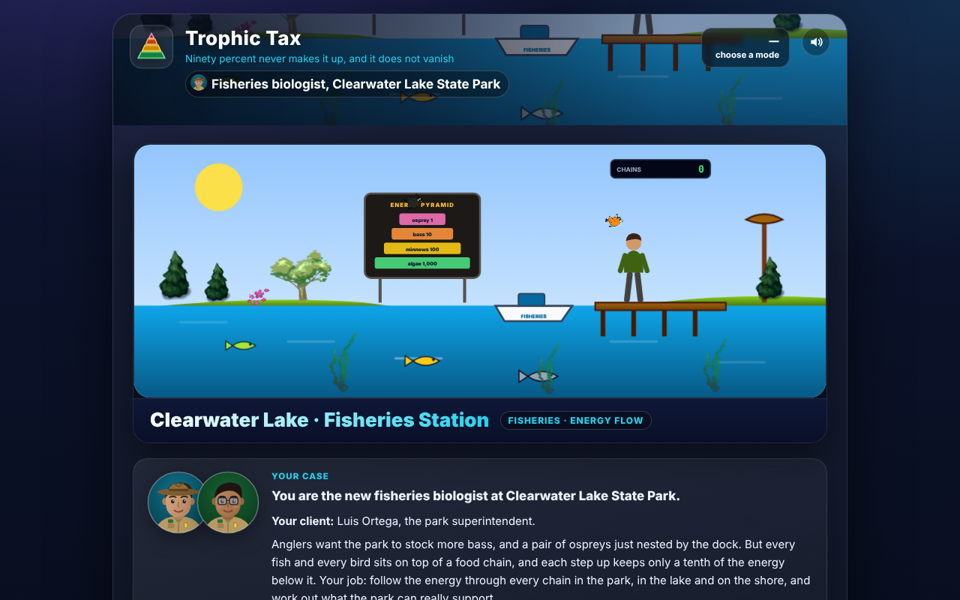
  • Energy pyramids and the 10 percent rule
  • Food webs
  • Photosynthesis
  • Cellular respiration
  • Osmosis and diffusion
  • Punnett squares
  • DNA mutations
  • Natural selection
  • Cladograms

Third Rock · Grades 6 to 8

Earth and space science games

"Moon phases are Earth's shadow." Most of the class agrees. It is wrong.

Middle school Earth and space science. Earth's shadow only matters in an eclipse; phases come from the viewing angle, and the game says so when a student picks the shadow.

  • Moon phases and eclipses
  • Reasons for the seasons
  • Gravity and orbits
  • Solar system scale
  • Rock cycle
  • Relative dating
  • Plate tectonics
  • Weather fronts
  • Greenhouse effect

Life Code · Grades 9 to 12

High school biology games

Hotter = faster? Not past the peak.

Genetics, evolution and ecology for high school biology. Push an enzyme past its optimum and it loses its shape; the game shows the rate fall to zero.

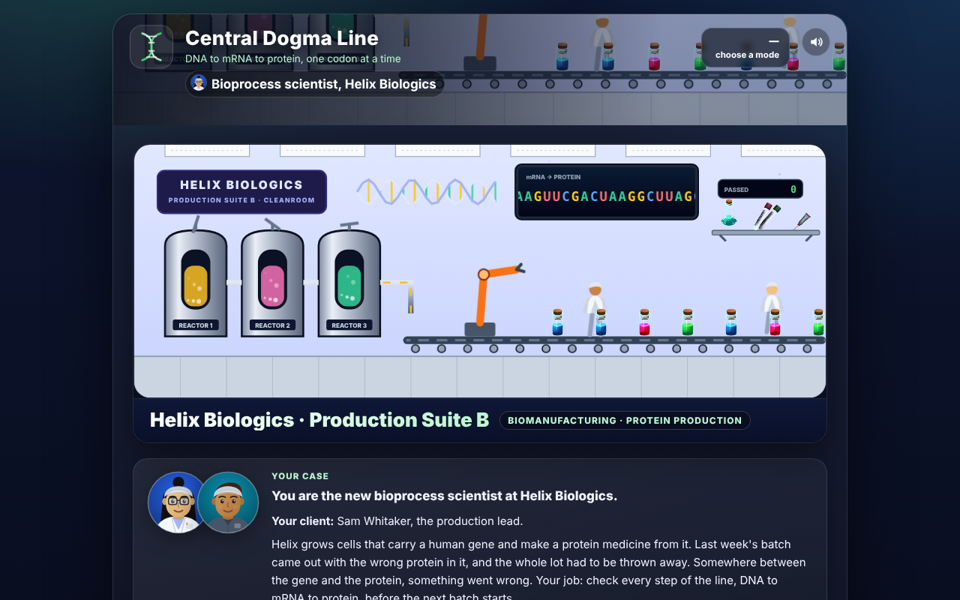
  • Protein synthesis
  • Enzymes
  • Homeostasis
  • Photosynthesis and cellular respiration
  • Mitosis and meiosis
  • Pedigrees
  • Natural selection and genetic drift
  • Population growth
  • Gene regulation

Wet Lab · Grades 9 to 12

Biology lab games with worksheets

Mitosis, now a game.

The classic biology labs as games, each paired with a printable worksheet: onion root tips, potato cores, food tests and gel electrophoresis.

  • Mitosis and the cell cycle
  • Macromolecules and food tests
  • Osmosis and cell transport
  • DNA replication and structure
  • Gel electrophoresis and PCR
  • Dihybrid crosses and chi-square
6 games, each with a printable worksheet

Mole Machine · High school chemistry

High school chemistry games

N₂ + 3H₂ → N₂H₆. The atoms balance. It is still wrong.

Stoichiometry, gas laws and bonding. Rewriting a formula balances the atoms and makes a different substance, and the game tells the student that in those words.

  • Balancing chemical equations
  • Mole conversions
  • Limiting reactant
  • Percent yield
  • Molarity
  • Gas laws
  • Electron configuration
  • Bond polarity

3D Lab Kits · Grades 6 to 12

3D science models with labeling worksheets

Science models you can turn, take apart and label.

Interactive 3D models that run in the browser, covering cells, the human body, plants, chemistry, Earth and space, and geometry. Each comes with a labeling worksheet and a printable poster.

  • Animal and plant cell
  • Cell membrane
  • Mitosis
  • DNA to chromosome
  • Protein synthesis
  • Mitochondria
  • Chloroplast
  • Leaf structure
  • Flower parts
  • Human heart
  • Respiratory system
  • Kidney
  • Small intestine
  • Brain
  • Neuron and synapse
  • Human eye
  • Ear and hearing
  • Skin layers
  • Muscle contraction
  • Knee joint
  • Atoms and molecules
  • Earth's layers
  • Seasons, moon phases and eclipses
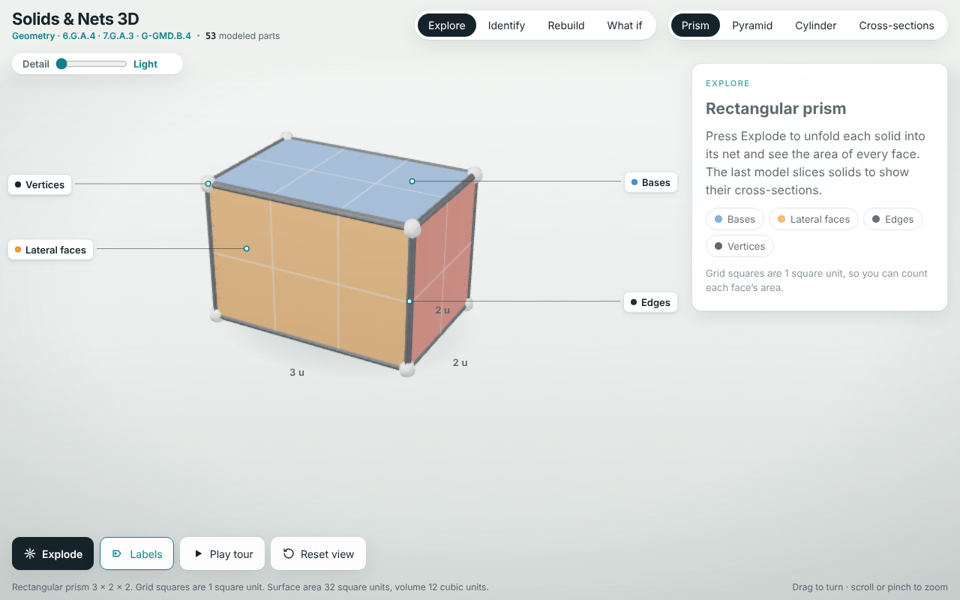
  • Nets, surface area and volume
  • Conic sections
More than 20 models, each with a worksheet and poster

ELA games

Grammar and writing for middle school.

Inkwell · Grades 6 to 8

Middle school grammar and ELA games

"The power went out, we played by flashlight." One sentence? It is a comma splice.

Grammar and writing for middle school. The game names the error, a comma splice or a dangling modifier, and shows the fix.

  • Fragments, run-ons and comma splices
  • Subject-verb and pronoun agreement
  • Clauses and sentence types
  • Comma rules
  • Active and passive voice
  • Greek and Latin roots
  • Figurative language and tone
  • Argument writing
  • Point of view

Teaching more than one course?

Two larger bundles put whole tracks together.

Questions teachers ask

How the games work.

Do the games work on Chromebooks?

Yes. Each game is a single HTML file that opens in the browser. It runs on a Chromebook, a laptop or a desktop, and it keeps working with no wifi once the file is open.

Do students need an account or a login?

No. Students open the game and play. There are no accounts, and the games do not collect, store or send any student data, so there is nothing for your district to approve.

How do I assign a game to my class?

Every download comes with a teacher guide that walks through four ways to hand it out: Google Classroom, Canvas, Schoology or a Google Site. You can also put the file on a shared drive.

How do the games handle different levels?

Every game has three levels, Rookie, Varsity and Nationals, so one file covers the whole room. Each game runs in six short acts that build from the idea to the hard cases.

What do I get as the teacher?

At the end each student gets a skill report showing what they have and what they missed. The teacher guide adds five discussion questions with model answers, a scoring rubric and the standards the game covers.

What does "catches the exact wrong move" mean?

Each wrong answer in a game is a real misconception, such as adding the denominators or reading the arrow backwards. When a student picks it, the game names that mistake and shows why it fails, instead of just marking it wrong.

Where do I buy the games?

The full catalog is in the Educator's Arcade store on Teachers Pay Teachers. Games are sold one at a time or as a bundle for each track, and every track has a free game to try first.